Developer Tools
Nexora AI
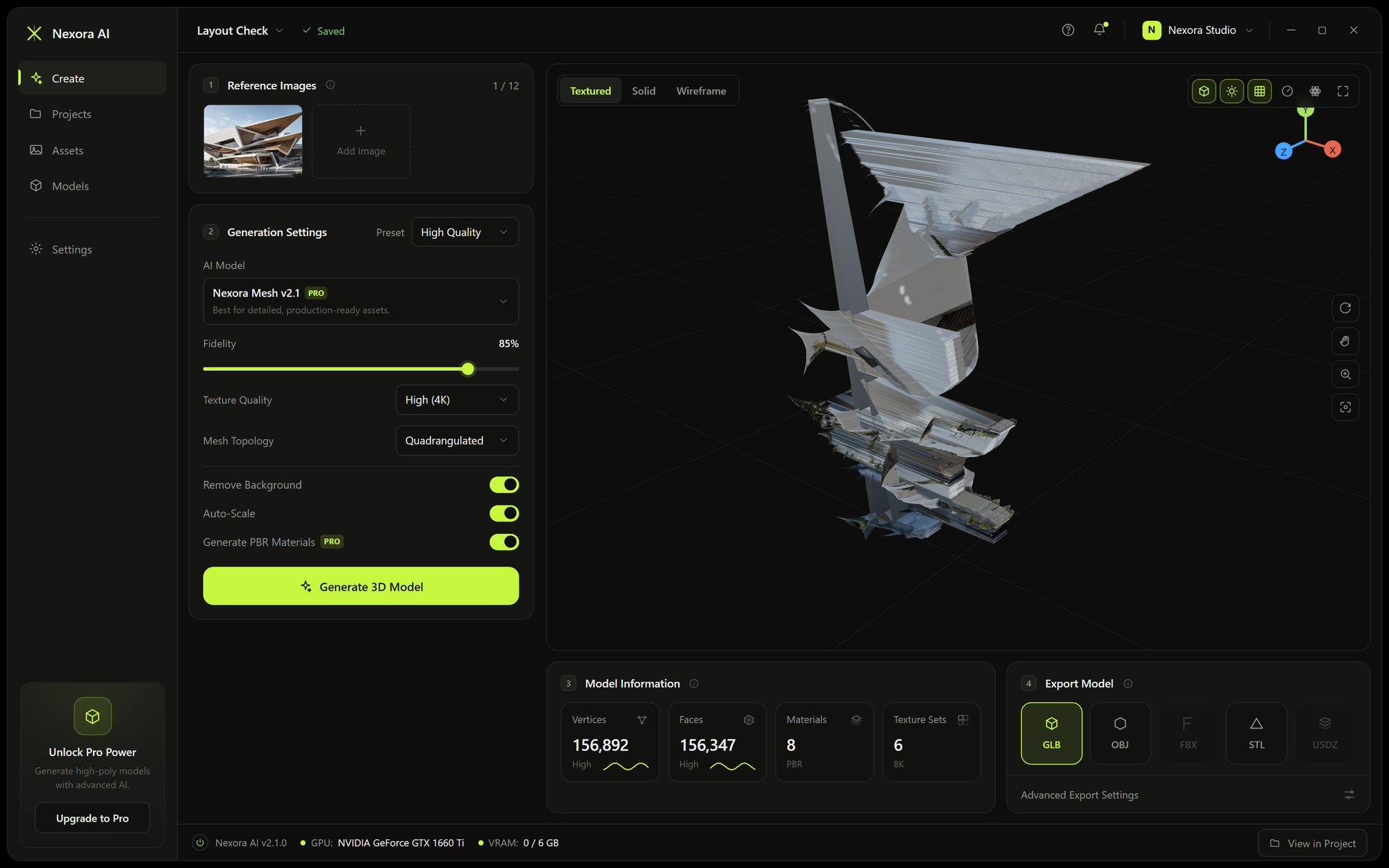
Turns a single image into editable, structured 3D rather than one undifferentiated blob mesh - a reconstruction engine and the desktop-style studio that drives it.
- Python
- NumPy
- PyTorch
- FastAPI
- React
- Three.js
- Blender
Overview
Most image-to-3D tools hand back a single mesh: watertight, plausible from the camera angle it was generated for, and impossible to edit afterwards because nothing in it is named. Nexora is built around the opposite goal - recover the structure, not just the surface. A silhouette becomes a contour, the contour becomes a scene graph describing intent rather than geometry, and that graph becomes commands a modelling package can replay. The repository holds both halves of that: an engine of 48 modules, and a FastAPI and React/Three.js studio that puts a reference image, generation settings and a live viewport in one window.
Engineering highlights
- Three reconstruction paths that are honestly different, not three names for one model: a deterministic algorithmic pipeline with no learned weights anywhere in it, sub-second silhouette inflation, and a trained neural decoder
- The shipping path is pure numpy - Otsu masking, corner-aware Douglas-Peucker contour tracing and rule-based scene graphs - so a wrong result can be stepped through and explained rather than reweighted
- Silhouette inflation treats the distance transform of the mask as a height field and stitches a front and back shell at the rim, after Igarashi's Teddy (1999): no GPU, sub-second, and candid that a busy render yields a slab
- The neural decoder was trained on Pix3D furniture, so every plan it emits outside that domain carries an advisory rather than confident nonsense
- Nothing outside the checkout is hardcoded: every external root resolves from an environment variable with a portable default, so a fresh clone runs on a machine that is not the author's
- Model weights are deliberately absent from git and published to Hugging Face instead, keeping the repository clonable in seconds
- 66 test files, 522 passing, plus a Blender add-on and GLB, OBJ, FBX, STL and USDZ export